- The degeneration of these ovarian follicles which do not ovulate during the menstrual cycle is known as atresia
- Scientist has thus far been unable to discover why this happens
- It could be an adaptation to internal fertilisation, i.e. If multiple ova are released during ovulation. multiple fertilisation can result in multiple embryos, which the uterus may not be able to accommodate for
- It is not possible to alter the gender of the offspring after fertilisation
- However, assisted reproductive techniques can be conducted to select the gender of the offspring by selecting the appropriate sperms
- Follicle-stimulating hormone (FSH) and luteinising hormone (LH) are secreted by the anterior pituitary gland when there are high levels of gondadotrophin-releasing hormone (GnRH) released from the hypothalamus (region in the brain)
- FSH stimulates the development of follicles which subsequently results in an increase in oestrogen production
- As oestrogen level increases, FSH is inhibited (negative feedback) while more LH continues to be secreted
- A peak in LH levels result in ovulation (release of the mature ovum from the Graafian follicle) and creation of the corpus luteum
- The corpus luteum secretes progesterone and oestrogen which leads to a decrease in levels of GnRH being released from the hypothalamus (negative feedback)
- The decrease levels of GnRH result in the decreased levels of FSH and LH until the end of the menstrual cycle before the cycle repeats
- PMS is the short form of pre-menstrual syndrome, hence the mood changes occur before menstruation during the luteal phase
- The cause is complex and a consequence of multiple factors, however symptoms often improve when ovulation is suppressed
- The symptoms may be a result of ovarian hormones (oestrogen & progesterone) affecting neurotransmitters such as serotonin
- Deficiencies in prostaglandin (hormones that have a role in uterine contraction) may also result in PMS
- Genetic factors also play a role in an individual from suffering PMS
- Read more here
- A potometer is a device used for measuring the rate of water absorbed by a leafy plant
- It is used to estimate the rate of transpiration (the major force that transports water up the plant)
- There must be no additional air bubbles in the set up except for the bubble that is the marking
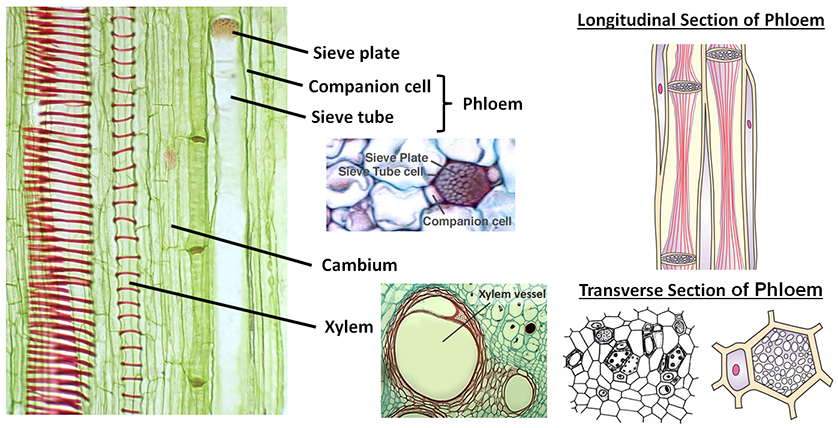
- Phloem tissues consist of sieve tubes and companion cells
- Sieve tubes are made up of sieve tube elements which are joined end-to-end
- End walls (cross-walls) of sieve tube elements are known as sieve plate
- Pores in sieve plates to allow rapid translocation of manufactured food (sucrose + amino acids)
- Each mature sieve tube element has lost most of its organelles, including the vacuole and nucleus, leaving only a thin layer of cytoplasm
- Each sieve tube element requires a companion cell to help it carry out its metabolic process
- Companion cells also contain many mitochondria that provides the energy needed for active transport of manufactured food into the sieve tube elements for translocation
- In metal, the atoms consist of a positive nucleus surrounded by a sea of electrons
- Since the electrons are in a sea, metallic atoms are able to exchange electrons with other metallic atoms
- Electrons move due to a difference in electric potential from a higher electric potential to a lower electric potential
- The difference in electric potential is a result of the reduction potential in the electrochemical series of metals
- Since electrons are attracted to the positive charge (lower electrical potential), they will move towards it, creating a current
- As the positive charge receives the electrons, it becomes less positive, and the positive charge gets negated by the negative charge from electrons
- When the positive end gets negated, so that there is no charge, then is no more movement and hence no more current
- When the two ends of the circuits contain the same charge (e.g. negative and negative), there is no electric potential so the electrons will not travel and hence they also do not travel through the resistors in such a scenario
- If the circuit is connected to both a positive and a negative end, the electrons can travel through the resistor as there is an electric potential. However, the resistor absorbs part of the energy of every electron, slowing them down, and dissipates it, so the rate of flow (current) decreases
- Here is the summary of my B.Sc. Research:
- Here is the summary of my Masters Research (I can't provide the details since I have not published the data):
- Not all species of Drosophilidae have larvae that feed on rotting fruits and plant matter. One such larvae that has be claimed to be a predator of whitefly is from the genus /Acletoxenus/. This was proved to be true where I provide the first video evidence of predation by a Singapore /Acletoxenus/ species on /Aleurotrachelus trachoides/. I demonstrated that the larvae have morphological adaptations for predation because the cephaloskeleton lacks the pharyngeal filter and a developed facial mask. Furthermore, I showed that the morphological features that have been traditionally used for distinguishing /Acletoxenus/ species (colour patterns on mesonotum) vary across individuals of one population and conclude that the Singapore species is most likely /Acletoxenus/ cf/. indicus/. I studied the natural history of /Acletoxenus/ cf/. indicus/ and find it to have a long development time of 24 days. It was also commonly parasitized by /Pachyneuron leucopiscida/ (43% of puparia).
- Through performing a comparative analysis of larva transcriptomics, I found that the relatively highly expressed genes in /Acletoxenus/ cf/. indicus/ are involved in odorant reception, chitin metabolism, alkaloid biosynthesis, and producing glue for pupation. The results also imply that many genes that are only moderately expressed in /Acletoxenus/ cf/. indicus/ are relatively high expressed in /Drosophila/ /melanogaster/ homeostasis and development.
- Lastly, I tested whether the phylogenetic relationships of Drosophilidae can be resolved using NCBI GenBank data so that I can place /Acletoxenus/ on the tree of life. Two methods (supermatrix and supertree) were used but the results were not satisfactory in terms of resolution, support, and congruence with the existing classification. The relationships obtained for the Steganinae were very different from previously published phylogenies while there is better congruence for the Drosophilinae. /Acletoxenus/ cf/. indicus/ was found to be in a “basal” position in the maximum likelihood analyses while it is nested in a clade consisting of Gitonini and /Colocasiomyia/ in the maximum parsimony analyses. I conclude that the available data in GenBank are currently insufficient for obtaining a well-resolved and supported phylogenetic hypothesis for Drosophilidae.
- Assuming we don't trigger runaway climate change early, and assuming we have the technology to survive the next ice age when it comes in 50,000 years or so, and assuming we never develop the technology to colonize other planets or planetoids (otherwise the end of the world would not spell the end of humanity), it would happen for sure when the sun becomes a red giant (5.79 billion years from now)
- Yes definitely
- Examples include antimatter, hydrogen fuel cells, nuclear energy, ocean thermal energy conversion, hydroelectricity, Biomass energy (biofuel), wind energy, solar energy
- For a generator to spin, there must be an input of energy as energy cannot be created or destroyed but is converted from one form to another (1st Law of Thermodynamics)
- The 2nd law of thermodynamics state that the total entropy (measure of order in a system) of the universe increases in a spontaneous process (There will be a limit in the amount of energy available to be converted to kinetic energy, some energy has to be lost to increase entropy)
- Hence, the laws would forbid a vacuum microclimate for allowing a generator to spin forever as some of the energy is lost through friction between machine parts and radiation
¶ Is there a way to use gravity to bend time and space on earth?
- Gravity indeed bends time and space although the effects of earth's gravity are quite mild
- Only a black hole with a big gravitational energy would have an ability to bend time and space
- However, we are still unable to tap on this gravitational energy effectively to fulfill a specific purpose
- Read more about black holes here
- Definitely, read more about developments of neurotechnology here
- Yes, we are trying to develop it to treat post-traumatic stress disorder
- We don't know, they may or may not look like us (If they do look like us, this is called convergent evolution)
- Read more here
- There are people who are trying, but if it does get solved, it will have major implications in the banking industry as the 2 factor authentication method would have been cracked
- Compare the question to the fundamental principles and see whether it matches to these principles